
The Whispering Train of the Devon Coastline
Picture the Devon coast in the mid-1840s: pale cliffs above the sea, fishing villages tucked beside the Exe and Teign estuaries, and the sound of waves carrying across the railway works. A train passing along the shoreline might have been expected to announce itself with smoke, sparks, clanking rods and the sharp exhaust of a steam locomotive. Brunel imagined something very different. His proposed atmospheric railway would glide with remarkably little noise and no smoke from an onboard engine, offering passengers a cleaner view of the coast as they travelled west from Exeter.
The idea formed part of Isambard Kingdom Brunel”s ambitious plan for the South Devon Railway, intended eventually to connect Exeter with Plymouth across difficult coastal and inland terrain. The route demanded sharp curves, exposed embankments, estuary crossings and steep climbs beyond Newton Abbot. Instead of hauling a heavy locomotive over every gradient, Brunel hoped to let the atmosphere do the pulling. The concept was bold, elegant and perfectly suited to the age”s appetite for technological progress. It was also dependent on a deceptively simple condition: a long leather seal had to remain airtight in the damp, salty Devon weather.
Why Victorian Steam Hit a Wall in the South West
Early steam locomotives had already transformed British travel, but they were not light, flexible machines by modern standards. Their boilers, water supplies, coal bunkers and driving machinery formed a substantial mass that had to be moved even when the train itself was relatively short. On a route such as the South Devon line, that dead weight mattered. The railway followed a demanding landscape, with coastal curves and gradients that placed severe demands on traction, braking and track design.
Brunel was not rejecting steam because it was useless. He was looking for a way to extend railway travel into country where conventional operation was expensive and technically awkward. He also had a grander project in mind. The Great Western Railway had reached Exeter in 1844, and Brunel wanted the broad-gauge railway to continue towards Plymouth. A propulsion system that could climb steep gradients without carrying a locomotive might reduce fuel use, simplify the trains and make difficult sections more manageable.
- Heavy locomotives consumed fuel simply to move their own machinery.
- Steep gradients demanded careful management of traction and braking.
- Sharp coastal curves placed additional stress on wheels, rails and locomotive components.
- Locomotive depots, crews, water supplies and maintenance all added to operating costs.
Brunel had encountered atmospheric propulsion demonstrations associated with Samuel Clegg and Jacob Samuda, including the atmospheric railway between Kingstown and Dalkey in Ireland. The system promised quiet running, smooth acceleration and the ability to handle gradients without a locomotive attached to every train. There were warnings. Engineers including Robert Stephenson and Daniel Gooch questioned whether the technology was reliable enough for a major railway. Brunel nevertheless accepted responsibility for the decision, convinced that its potential justified the risk.
The Science of Moving Trains with Pure Air Pressure
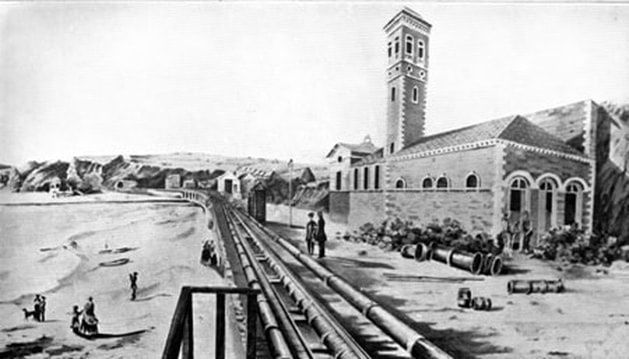
The principle behind the Clegg and Samuda system was straightforward, although applying it over a working railway was anything but simple. A large cast-iron pipe was laid between the running rails. Inside the pipe was a piston connected to the train by a vertical arm. Pumping engines housed in trackside stations extracted air from the pipe ahead of the piston. Once a vacuum had been created, normal atmospheric pressure behind the piston pushed it towards the evacuated section, drawing the train along the track.
In practical terms, the train did not carry its own main source of propulsion. Instead, pumping stations positioned at intervals, roughly every three miles on the South Devon installation, prepared sections of pipe for the approaching service. The train had to communicate with the pumping stations and arrive within the operating sequence, which made scheduling and signalling more complicated than on an ordinary locomotive railway. Atmospheric pressure supplied the force, but steam engines were still required at the pumping stations to create that pressure difference.
| Atmospheric railway | Conventional steam railway |
|---|---|
| A trackside piston pulled the train through a vacuum | An onboard locomotive transmitted power through its wheels |
| Steam engines operated at fixed pumping stations | Steam engines travelled with every train |
| Potentially quieter and free from locomotive smoke | More smoke, noise and moving machinery along the route |
| Dependent on a continuous airtight seal | Dependent mainly on locomotive maintenance and fuel supply |
The promise was considerable. Atmospheric trains could be smooth and fast, and trials on the Exeter to Newton Abbot section reportedly reached speeds of up to 45 mph, with some accounts describing even higher brief speeds. The system began full timetable operation in 1848. For passengers, the experience must have seemed almost magical: a train moving without the visible effort of a locomotive, powered by an invisible force that had been present all around them since the beginning of time.
When Rats and Seawater Sabotaged the Future of Transit
The central weakness lay in the pipe”s valve. A longitudinal opening ran along its upper surface so that the connecting arm from the piston could reach the train. This opening had to be covered by a flexible leather flap. The leather was treated with tallow, an animal fat, to help it remain supple and form an airtight seal. On paper, the arrangement was ingenious. In the real world, it created a maintenance problem stretching for miles beside an exposed maritime railway.
Devon”s winter frosts could harden the leather, while sea spray, rain and damp air attacked the material in other ways. When the seal dried, cracked or failed to sit correctly, the vacuum escaped. The pumping engines then had to work harder and burn more coal to achieve the same pressure. Labourers were required to inspect, grease and repair the valve continually, turning the supposed economy of atmospheric propulsion into an expensive routine of manual maintenance.
Then came one of the most memorable engineering nuisances in railway history. Rats were attracted to the tallow. They gnawed the treated leather, creating additional holes and leaks along the pipe. The problem was not a single dramatic breakdown but a steady assault by weather, wear and hungry animals. Each leak reduced the system”s efficiency, and each attempt to restore the vacuum increased fuel consumption and operational uncertainty.
- The pumping station evacuated air from the pipe ahead of the train.
- A damaged leather seal allowed air to enter the pipe.
- The vacuum weakened, reducing the force available to move the piston.
- Pumps consumed more coal while staff searched for and repaired leaks.
- Services became costly, unreliable and increasingly difficult to schedule.
The system also suffered from underpowered pumping engines, freezing conditions and inadequate communication between stations. By June 1848, operating costs had overtaken those of locomotive haulage. Brunel eventually advised that the experiment should not be extended unless the manufacturers could guarantee a satisfactory solution. The directors ended atmospheric operation on 9 September 1848, after less than a year of regular service. The railway returned to conventional steam locomotives, and the company faced losses estimated at about £500,000.
Surviving Relics You Can Still Visit in Devon
The atmospheric railway disappeared from daily operation, but its buildings left a distinctive architectural legacy. Pumping stations were often designed in an Italianate style, giving them a more refined appearance than the purely industrial sheds that housed many Victorian railway facilities. Starcross, standing near the railway and the Exe estuary, is among the best-known surviving reminders. Totnes Atmospheric Pumping Station is another important survivor and one of three associated with the Exeter to Newton Abbot route.
Totnes is particularly valuable because its story continued after the atmospheric experiment ended. The building later formed part of a milk-processing factory, a reminder that historic structures often survive by adapting to practical local needs. Following a campaign against demolition, it was listed Grade II in 2008. Heritage organisations, museums and railway societies now help preserve the wider Brunelian landscape, from broad-gauge history to the machinery, buildings and working practices of the Great Western Railway era.
- Visit the area around Starcross for views across the Exe and a strong sense of the original coastal setting.
- Look for information about Totnes Atmospheric Pumping Station before travelling, as access arrangements may vary.
- Walk sections of the sea wall between Exeter and Newton Abbot to appreciate the route”s curves, gradients and exposure.
- Pair a Devon visit with a railway heritage centre such as Didcot Railway Centre, where Great Western structures, rolling stock and broad-gauge interpretation bring the period to life.
A walk along the sea wall is especially rewarding because the landscape explains the engineering challenge better than any diagram. The railway threads between cliffs, water and built-up settlements, with little room for easy realignment. On a calm day, it is possible to imagine a nearly silent train moving beside the waves, while the pumping stations worked at intervals behind it. The surviving buildings turn that imagined journey into something tangible, connecting modern travellers with the ambitions and frustrations of Victorian transport.
How an Audacious Victorian Failure Shaped Modern Travel
Brunel”s atmospheric railway failed as a commercial system, but failure does not make an engineering experiment worthless. The project tested a radical idea under demanding conditions and exposed the difference between a mechanism that works in demonstration and one that can survive daily service, changing weather, maintenance shortages and financial pressure. The railway reached impressive speeds and briefly offered a smooth, smoke-free alternative to locomotive haulage. Its downfall came from the organic vulnerability of the seal and the costs of keeping a complex system operational.
The underlying idea has never entirely vanished. Pneumatic tubes still move documents and small objects through buildings, while modern transport concepts such as vacuum-assisted or low-pressure tube systems revisit the relationship between air pressure and rapid travel. The comparison should not be taken too literally, since contemporary materials, control systems and safety standards are vastly more advanced. Yet the intellectual link is clear. Brunel”s experiment belongs to a long tradition of trying to remove friction, weight and energy loss from transport.
The South Devon Atmospheric Railway therefore deserves more than a footnote as an expensive Victorian curiosity. It was a serious attempt to solve a real problem on a difficult route, backed by one of the nineteenth century”s most inventive engineers. Its collapse was caused by rats, salt air, frost and flawed economics, but its ambition remains admirable. Along Devon”s coastline, the empty space between the rails still carries the memory of a train that was meant to be powered not by fire and steam, but by the air itself.

